Tencent Cloud2026-09-15 04:41:40Tencent Cloud partners with U Mobile to offer 5G and AI toolsTencent Cloud said it has entered a partnership with Malaysian telecom operator U Mobile to provide 5G and artificial intelligence tools for enterprises in Southeast Asia. The company said the arrangement marks its first official AI partnership with a telecom operator in Malaysia. The update was carried by Techub, which cited Tech in Asia. No further commercial terms or rollout details were disclosed in the source brief.290
Tencent2026-09-11 16:32:27Tencent open-sources Hunyuan Hy4 preview with 770B parameters and 1 million-token contextTencent Hunyuan released and open-sourced its next-generation large language model, Hy4 preview, on Aug. 28. The model has 770 billion total parameters, activates 49 billion parameters per token, and supports a context window of more than 1 million tokens. Its weights have been published on Hugging Face under the Apache 2.0 license. According to Xinhua, Tencent positions Hy4 preview as a model built for productivity, targeting software engineering, office analysis, game development, and scientific research. The release adds to a recent run of open model launches by major Chinese technology companies, following Zhipu’s GLM-5.3 and the DeepSeek V4 series. Tencent’s model card says Hy4 preview uses a 78-layer mixture-of-experts architecture, includes FP8 quantization and speculative decoding support, and can be deployed in an example setup using eight GPUs for tensor parallelism. Tencent also disclosed benchmark and internal blind-test results, while noting that third-party independent verification has not yet been completed. The model is available through Tencent Cloud Tokenhub and OpenRouter, and has been integrated into WorkBuddy and CodeBuddy.1170
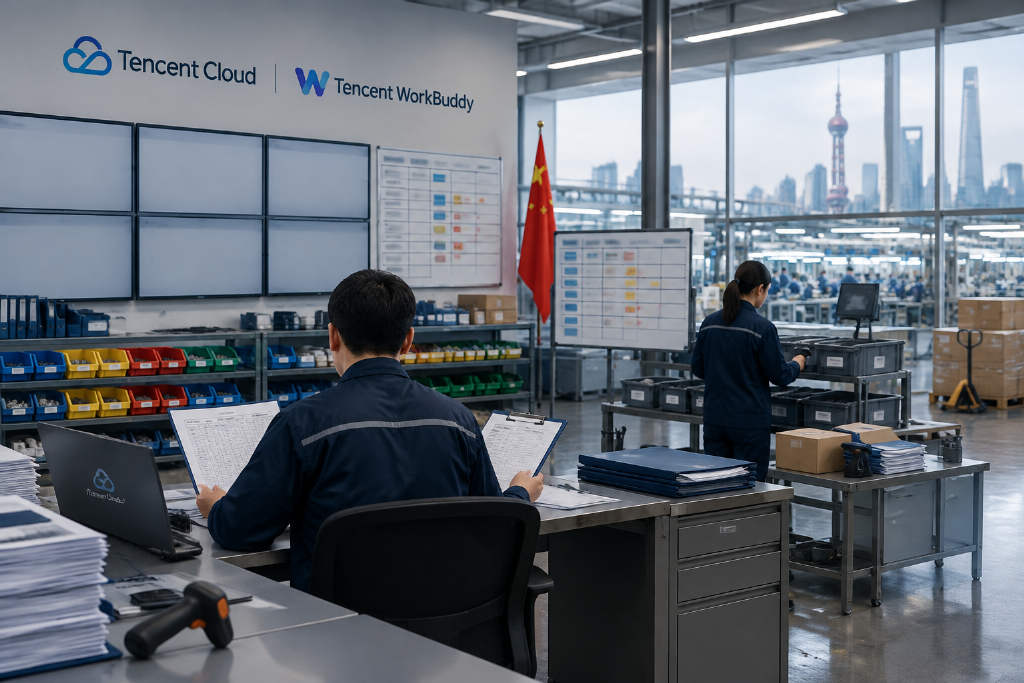
manufacturing2026-09-10 11:33:09Manufacturing AI agents start with data handoff gaps, white paper saysTencent Research Institute, Tencent Cloud and Tencent WorkBuddy have released a white paper titled "Toward Adaptive Manufacturing: A Practical White Paper on AI Agents in Manufacturing," outlining how manufacturers are introducing AI agents into daily operations. The report argues that the first viable landing spot for these agents is usually not the factory floor itself, but the gaps between enterprise systems, where data is fragmented, standards differ and staff still rely on manual coordination. It frames an agent as truly "on the job" only when its output can be accepted, verified and traced inside an existing chain of responsibility. The paper lists seven findings, including the need to build agents task by task, connect them to real business systems, and convert employee know-how into explicit, executable rules. It also uses several examples to show what that looks like in practice, including BOM baseline checks, short-term production rescheduling by PMC teams, material shortage reviews, and joint inventory-price decisions in supply chains. The paper says one BOM revision review can cut manual effort from 3-5 hours to 0.5 hours, while a PMC urgent order adjustment can reduce end-to-end response time to 15 minutes. It also cites case studies from Guangzhou Vision and Zhuhai Tonly Foma, and says the white paper covers typical task scenarios across seven roles and implementation experience from three representative companies.240
Blockchain2026-09-02 09:49:55IDC: China Blockchain BaaS Market Reaches 2.07 Billion Yuan in 2025, Ant Group LeadsIDC's latest report reveals China's blockchain BaaS market reached 2.07 billion yuan in 2025, up 7.4% YoY. Ant Digital Technologies led with a 32.4% share and 20.6% growth, followed by Tencent Cloud and Inspur. Trusted data spaces and AI large models are new growth drivers. AntChain, Ant's blockchain arm, holds the most patents globally and supports 2 billion accounts with 100,000 TPS.1010
Tencent Cloud2026-08-29 03:18:30Tencent Cloud Launches AI Agent Suite in Indonesia, Targets Southeast Asia GrowthTencent Cloud has rolled out an AI agent suite in Indonesia, offering local companies custom AI tools for game development, 3D web design and accounting compliance. The launch is part of Tencent Cloud's AI services expansion across Southeast Asia and is intended to strengthen its position in regional markets, according to Tech in Asia. The suite is built on Hy4, an expert-level AI model from Tencent that the company previously tested in its Yuanbao app.990
Tencent Cloud2026-08-04 08:30:12Tencent Cloud extends free Hy3 model access for Buddy users through Aug. 31Tencent Cloud has extended its limited-time free access program for Hy3 model calls in CodeBuddy and WorkBuddy through Aug. 31, 2026, according to a notice tracked by Dongcha Beating. The company said demand for the free trial has been high, prompting it to allocate daily free quotas to help ensure that each Buddy user can continue to access the service. Tencent also said that users may be placed in a queue when resources are busy on a given day. In those cases, the page will display a reset time for service recovery. The update applies specifically to Hy3 model usage inside CodeBuddy and WorkBuddy.2120
MoneyFrontier2026-07-30 05:03:00MoneyFrontier summit spotlights four shifts in AI compute, from domestic GPUs to AIDC upgradesAt the MoneyFrontier 2026 New Infrastructure Intelligent Computing Summit held on July 28 at Hong Kong’s Hopewell Hotel, executives from Moore Threads, Tencent Cloud, Yanji Microelectronics and Xinke Liquid Cooling outlined how the AI compute chain is changing shape. Their talks converged on a common view: the market is moving away from a simple race over who owns the most GPUs and toward a harder question of who can turn compute capacity into usable production systems. Moore Threads said domestic GPUs are entering a “token era,” where demand is no longer defined by chip performance alone but by full-stack support across training, inference, simulation, agent runtime and end applications. Tencent Cloud focused on the rise of AI agents, arguing that enterprise deployment now depends on memory, knowledge management, tool use, multi-agent coordination and secure execution environments, not just large models. Yanji Microelectronics founder Yang Zuoxing said the training market has become concentrated and that new openings are more likely to emerge on the inference side, especially as AI applications, agents and robots spread toward regional and edge scenarios. Xinke Liquid Cooling, for its part, said the shift from traditional data centers and blockchain mining sites to AIDC facilities is an engineering overhaul involving power, cooling, networking, fire protection, operations and delivery standards.1950
Tencent2026-07-28 09:44:57Tencent’s WorkBuddy hits 20 million MAUs three months after public launchTencent’s AI-native desktop agent workspace WorkBuddy reached 20 million monthly active users across platforms within three months of its March 9 public beta, according to Z Finance, with daily active users topping 13 million and PC DAU exceeding 2 million. The product is led by Tencent Cloud Vice President Liu Yi, backed by a core team of around 100 people, and is reportedly listed internally as one of Tencent’s highest-priority AI projects. The team said it has only “temporarily pulled ahead by half a body length.” WorkBuddy evolved from Tencent’s earlier AI coding assistant CodeBuddy, which has already covered about 12,000 engineers inside the company. The product completed prototype development on Jan. 17 and, after entering public beta in March, went through 43 iterations while gradually integrating QClaw-related capabilities developed by the Tencent PC Manager team on top of an open-source framework. It uses a multi-model access strategy coordinated by Tencent’s in-house Harness engine. On monetization, Tencent Cloud raised pricing at the end of April, increasing the SaaS enterprise edition from 78 yuan per user per month to 198 yuan, and the private cloud enterprise edition from 158 yuan to 316 yuan. Market information cited in the report said WorkBuddy has already won thousands of enterprise clients and more than 100,000 paid seats, with estimated annualized revenue of around 300 million yuan.2470